Best iOS Apps for Sonarr and Radarr in 2026: Helmarr, Ruddarr, and LunaSea Compared
If you run Sonarr and Radarr from an iPhone, the obvious question is not just “which app opens my movie and TV lists?” It is whether the app still helps once the stack grows into download clients, indexers, request tools, playback monitoring, remote access, and server health.
On iOS in 2026, the names most people run into are Helmarr, Ruddarr, and LunaSea. They are not trying to be the same product. One is built around the whole stack, one focuses tightly on Sonarr and Radarr, and one was an important cross-platform option whose development has stopped.
We build Helmarr, so this is written from our point of view. The useful question is still simple: which one fits the setup you actually run?
What matters in a Sonarr and Radarr app
A good mobile client needs more than a list of movies and shows.
- Service coverage. Most real media stacks include Prowlarr or NZBHydra2, qBittorrent or SABnzbd, Seerr or Overseerr, Tautulli, Plex, Unraid, SSH, and now tools like Tdarr.
- Connected context. It is useful when a request, search, queue item, active stream, and server warning can live near each other instead of being split across six web UIs.
- Native feel. A self-hosted stack may be technical, but the phone app should still feel fast, readable, and at home on iOS.
- Remote access. Reverse proxies, Cloudflare Access, Pangolin, custom headers, and service tokens matter because most people check their stack away from home.
- Maintenance. These services change. A client that stops moving eventually drifts away from the APIs underneath it.
Quick comparison
| App | Best fit | Scope | iOS feel | Status |
|---|---|---|---|---|
| Helmarr | Whole-stack Apple users | Sonarr, Radarr, Lidarr, request tools, download clients, indexers, Plex, Emby, Tdarr monitoring, Unraid, SSH, and more | Native SwiftUI for iPhone, iPad, and Mac | Active |
| Ruddarr | Focused Sonarr/Radarr setups | Sonarr and Radarr | Native SwiftUI | Active |
| LunaSea | Existing users of the older cross-platform app | Broad historical support | Cross-platform Flutter | Development stopped |
Helmarr
Helmarr is built for people whose stack has outgrown a single app pair. Sonarr and Radarr are part of it, but so are Lidarr, Bazarr, Prowlarr, NZBHydra2, Jackett, qBittorrent, Transmission, Deluge, SABnzbd, NZBGet, Seerr, Overseerr, Jellyseerr, Tautulli, Jellystat, Tracearr, Plex, Emby, Tdarr monitoring, Unraid, SSH, SFTP, and Wizarr.
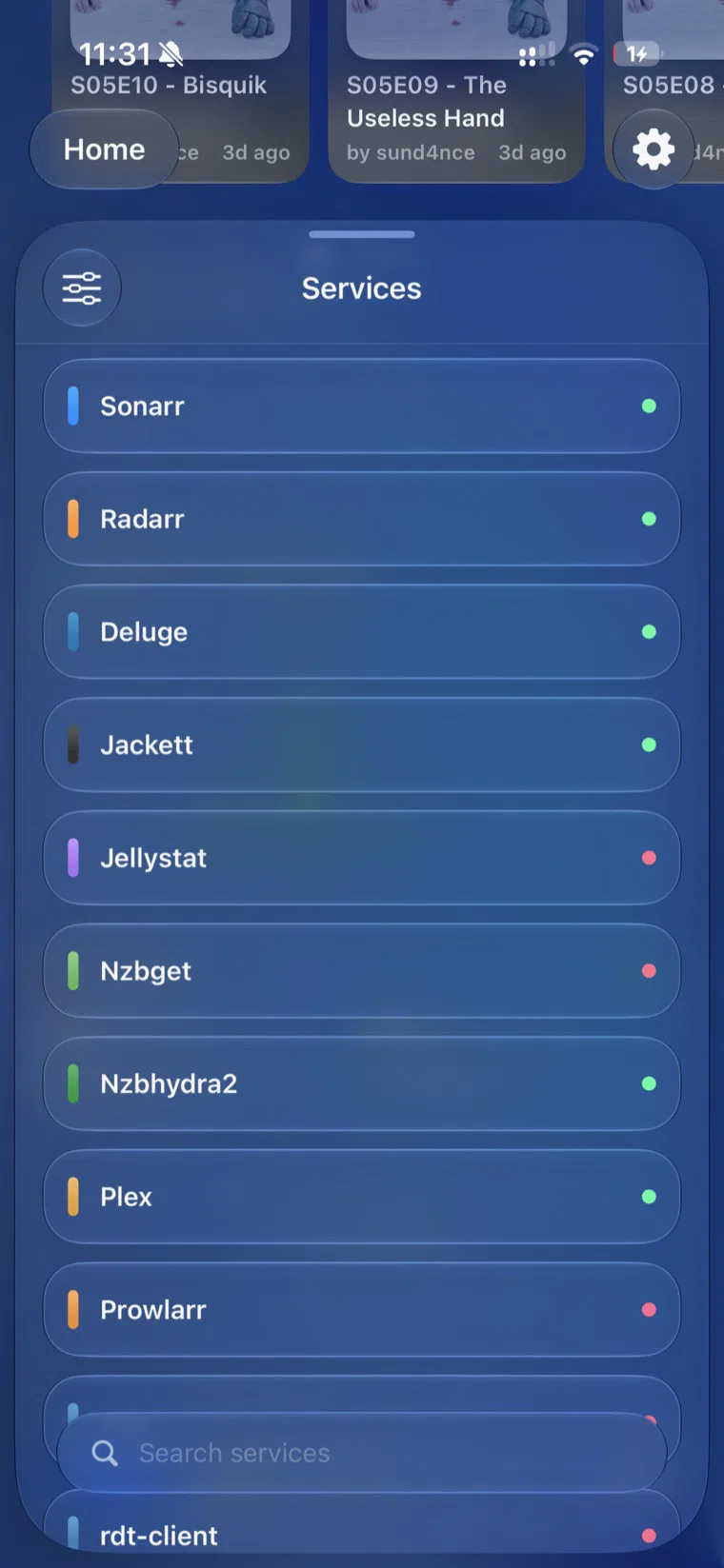
Helmarr is built around the stack as a whole, not only a single Sonarr or Radarr screen.
That breadth is not there for a badge count. It changes the workflow. You can check what Sonarr is trying to grab, see whether qBittorrent or SABnzbd is actually moving, approve a request, notice an active Plex stream, and keep an eye on the host without jumping through browser tabs.
Helmarr connects directly from your device to your own services. There is no hosted control plane sitting in the middle of your stack. It also supports multi-network setups and custom headers, so the same service can use a fast LAN address at home and a Cloudflare, Pangolin, Traefik, Caddy, or Nginx Proxy Manager URL when you are away.
It is a free App Store download with optional premium features. Helmarr has a 4.8 rating with more than 500 ratings, which is a good signal that the native-app approach is landing with the people actually running these stacks every day.
Ruddarr
Ruddarr is a clean, focused app for Radarr and Sonarr. If your media setup really is just those two services, it can be a pleasant fit: movie and series management, calendar views, queue and history, multiple instances, iCloud sync, appearance customization, and notifications through its paid push infrastructure.
The trade-off is intentional scope. Ruddarr does not try to be a command center for download clients, indexers, request tools, playback analytics, or server health. For a small setup that can be fine. For a typical self-hosted media stack, it means the app covers the media managers and leaves the rest of the day-to-day checks somewhere else.
LunaSea
LunaSea deserves credit. For years it was the broad, cross-platform self-hosted controller people recommended when they wanted more than a single-service remote.
The practical issue in 2026 is maintenance. LunaSea has been shut down and archived. Existing installs may keep working until a service API or hosted dependency changes, but it is no longer the app to pick if you are starting fresh and want something that will follow Sonarr, Radarr, request tools, and download clients as they evolve.
Which one should you choose?
Choose based on how your stack actually behaves on a normal week.
- Only Sonarr and Radarr: Ruddarr is a reasonable focused choice, and Helmarr still works if you want room to grow.
- Sonarr, Radarr, indexers, downloads, requests, and playback monitoring: Helmarr is the better fit because those pieces belong in the same daily view.
- A stack exposed through Cloudflare, Pangolin, or another reverse proxy: Helmarr’s custom headers and network-level settings are built for this exact problem.
- An existing LunaSea install that still works: there is no need to panic, but it is not the strongest long-term choice for a new setup.
The short version: if your iPhone is only a Sonarr/Radarr remote, you have options. If you want one native Apple app for the stack around Sonarr and Radarr, Helmarr is the one built for that job.
Helmarr is available on the App Store for iPhone, iPad, and Mac.